How to Win Visibility in AI-Powered Search | Veenso
SEO Isn't Dead, It's Bigger: How to Win Visibility in AI-Powered Search | Veenso
SEO Isn't Dead — It's Bigger Than Rankings Now
For years, SEO worked like a formula: find a keyword, optimize a page, build some backlinks, rank on Google, collect traffic.
That formula still works, in a narrow sense. But it no longer describes what SEO actually is.
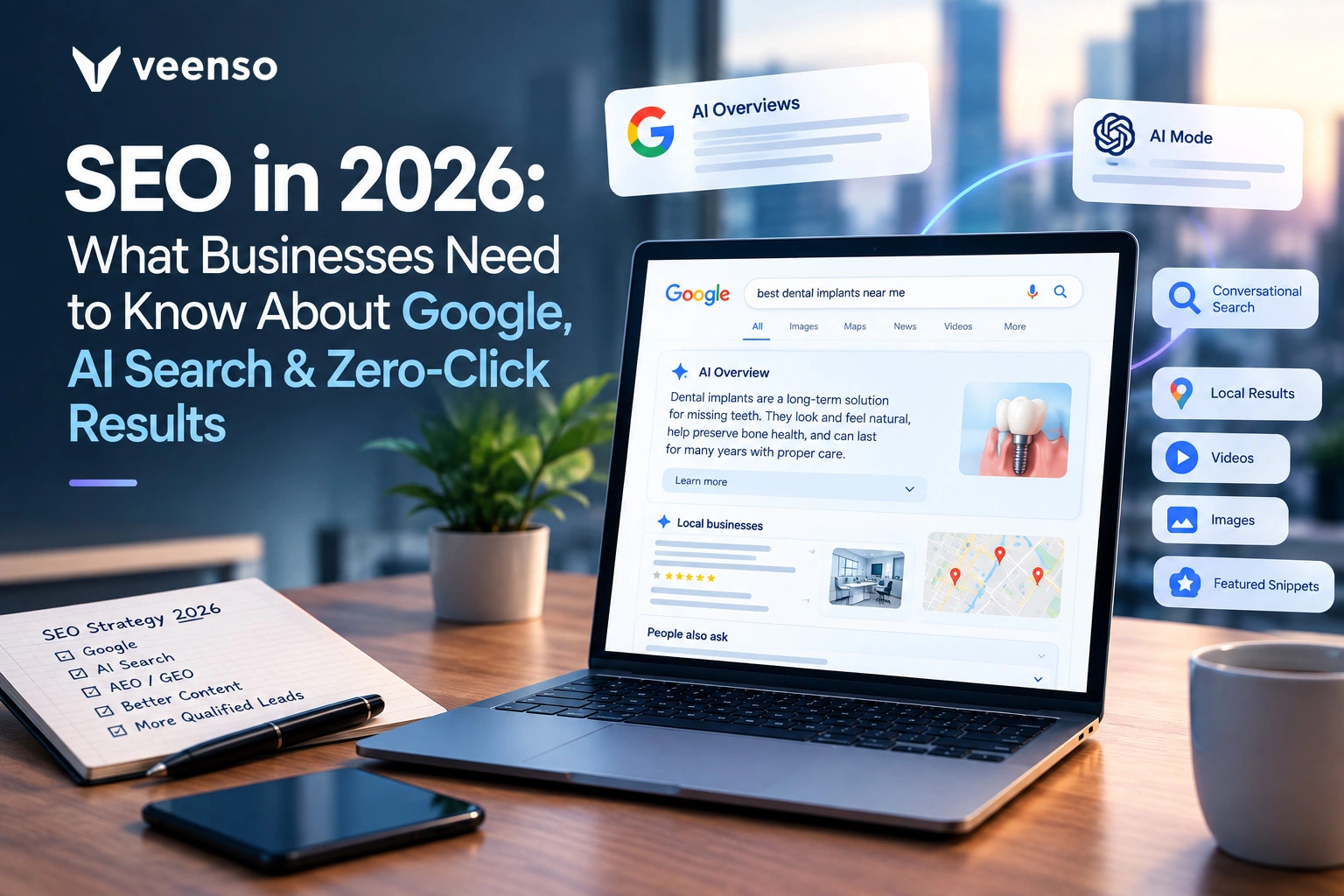
Search today happens across AI-generated answers, conversational follow-up questions, local map results, video, and traditional blue links — often in the same session, for the same query. People increasingly get an answer before they ever click a website. And the systems generating those answers still have to pull their information from somewhere.
That "somewhere" is the open web — which means the businesses that make themselves clear, credible, and easy to understand are the ones that keep showing up, no matter how the interface around search keeps changing.
This is the shift businesses need to plan for: SEO is no longer about ranking a page. It's about making your business legible to every system that helps someone make a decision — a search engine, an AI assistant, a maps app, a voice query, or whatever replaces those in a few years.
Search Has Moved From Keywords to Intent
The clearest change in how people search isn't a platform — it's the shape of the question.
A user searching a decade ago might type:
"best dentist Miami"
The same person today is more likely to ask something closer to:
"What's the best way to replace a missing tooth without removing healthy teeth nearby?"
That second query carries context, constraints, and intent that the first one never captured. Modern search systems — Google's AI-driven features included — are built specifically to parse that kind of question and route the person toward a useful, specific answer rather than a list of links to sort through themselves.
For businesses, that's not a threat. It's a filter. Vague, keyword-stuffed content struggles here. Specific, genuinely useful content — written for the actual question someone is asking — gets pulled forward.
The practical shift: stop starting content briefs with "what keyword are we targeting" and start with "what is the customer actually trying to figure out, and what would a genuinely good answer include?"
Zero-Click Search: When the Answer Never Needs Your Website
A zero-click search happens when someone gets what they need directly on the results page — no click required. Think:
- "What time does [business] open?"
- "How long does a root canal take?"
- "What's the average cost of X?"
AI-generated summaries have made this more common, not less, because a synthesized answer can now stand in for several individual page visits.
This raises a real question: if people don't click, how does appearing in search still help?
The answer is that a click was never the only valuable outcome — it was just the easiest one to measure. Appearing accurately and favorably in a zero-click answer still builds:
- Brand familiarity and recall
- Trust, before a purchase decision is made
- A higher chance of a branded search later ("just call [business] directly")
- Influence during comparison, even without a visit that day
The goal for a modern SEO strategy isn't "maximize clicks." It's maximize qualified visibility and the actions that follow it — clicks, calls, branded searches, and eventual conversions, tracked as a set rather than one metric in isolation.
A Search Result Is No Longer Ten Blue Links
Depending on the query, a single results page can now include AI-generated answers, local map packs, video carousels, product listings, "people also ask" boxes, knowledge panels, reviews — and, further down, the traditional organic listing.
That means competitors aren't only fighting for position one anymore. They're fighting for attention across an entire page, and often across an entire journey:
Search → AI-generated answer → local result → organic listing → video → website → conversion
A business can realistically occupy several of those positions for the same customer, in the same session. That's the actual opportunity — not "rank #1," but "show up credibly, more than once, in the places this specific customer is looking."
AI Search Doesn't Replace SEO Fundamentals — It Raises the Bar
This is the most common misunderstanding in this space, and it's worth stating plainly: AI-driven search features still depend on the open web for information. They read pages, evaluate structure, weigh credibility signals, and cite sources. A page that's poorly built, poorly written, or impossible to crawl doesn't get pulled forward just because AI is involved — if anything, it gets filtered out faster.
Every fundamental still matters:
- A crawlable, well-structured website
- Clear, accurate, genuinely useful content
- Strong internal linking and site architecture
- Credible external signals (mentions, links, reviews)
- Accurate, consistent business information everywhere it appears
AI search changes how information gets discovered and displayed. It does not remove the need for that information to be strong in the first place.
Answer Engine Optimization (AEO) and Generative Engine Optimization (GEO)
Two newer terms are worth understanding, without treating either as a replacement for SEO:
AEO (Answer Engine Optimization) is about structuring content so answer engines can extract a clear, correct answer from it — direct questions, direct answers, clean structure, minimal fluff before the point.
GEO (Generative Engine Optimization) is the broader practice of building a brand's visibility and credibility across generative AI experiences overall — not just one page, but the sum of what's said about a business across the web.
Neither is a separate discipline from SEO. SEO is the foundation. AEO and GEO extend that foundation into newer discovery surfaces — which is exactly why fundamentals-first content tends to outlast whatever the current buzzword is.
Original Content Is the Actual Differentiator
AI has made content production fast. It has not made generic content valuable — and search systems are explicitly built to filter out the former in favor of the latter. Google has been direct about this: large volumes of unoriginal, AI-assisted pages built primarily to manipulate rankings are treated as a quality problem, not a shortcut.
The issue was never "AI was used to help write this." The issue is content that adds nothing a hundred other pages don't already say.
Compare:
Generic: "SEO is important because it helps businesses get more traffic."
Specific: "Across the last dozen local-service clients we've audited, the highest-converting organic pages weren't the ones ranking #1 for a broad term — they were mid-funnel pages answering a specific pricing or process question, which is why we now prioritize those over broad head terms."
The second version can't be copy-pasted by a competitor. That's the point. Real experience, real data, and a real point of view are the only content advantage that doesn't erode over time.
Our Case Study →
Your Website Is Still the Foundation You Own
It's tempting to assume that as AI experiences grow, the website itself matters less. It's the opposite.
Every platform other than your website can change its rules without asking you: social algorithms shift, ad costs rise, AI platforms change how they summarize and cite sources, search interfaces get redesigned. Your website is the one asset where you still control:
- Messaging and positioning
- Service and pricing information
- The conversion path, start to finish
- First-party data and analytics
- The customer experience once someone arrives
Search visibility that leads to a weak, confusing, or slow website is visibility wasted. SEO and conversion strategy have to be built together, not handed off separately.
Traffic Isn't the Goal — Growth Is
More organic visitors is not automatically more revenue. A site can grow traffic and still stall on results if it has:
- Weak or missing calls to action
- Confusing navigation or slow load times
- No clear next step for the visitor
- Thin trust signals (no reviews, no proof, no clarity on what happens next)
The right question isn't "how do we get more visitors." It's "how do we get the right visitors, and give them an obvious path to becoming a customer."
Web Design & developement→
Local Search Still Decides a Lot of Buying Decisions
For any business tied to a physical service area — clinics, law firms, contractors, home services, local retailers — local search remains one of the highest-intent parts of the entire search landscape. "Near me" and city-specific queries convert differently than broad research queries, because the person searching is usually close to a decision already.
A strong local strategy connects, rather than treats separately:
Business profile management + website + local content + reviews + accurate business data + local backlinks/mentions + a fast conversion path
The goal is simple to state and harder to execute: be both easy to find and easy to trust, in that order.
SEO Service →
Building a Search Strategy That Doesn't Expire
Instead of a strategy tied to this year's algorithm update, build around principles that hold regardless of which interface search takes next:
1. Get the technical foundation right. Crawlability, indexation, site speed, mobile usability, structured data, clean architecture. Unglamorous, and still the floor everything else stands on.
2. Build content around real customer questions, not keyword volume. Start every content decision with: what does this person need to know before they choose us?
3. Build topic authority, not isolated articles. One page rarely establishes expertise. A cluster of interlinked pages — covering a topic from multiple real angles — does.
4. Build brand authority beyond your own pages. Original research, named experts, credible mentions, reviews, and real case studies compound in a way that any single page can't.
5. Design for every surface, not just the results page. Traditional listings, AI-generated answers, maps, video, images — a modern strategy accounts for all of them, not just the one that used to matter most.
6. Fix the conversion path. Discovery without a clear next step is a wasted opportunity. Every important page should make the next action obvious.
7. Measure the full picture, not just rank position. Impressions, qualified traffic, leads, calls, form fills, branded search growth, and — where platforms make it visible — appearances inside AI-generated answers. Rankings are an input, not the outcome.
None of these seven depend on which specific AI feature Google or anyone else ships next. That's the point — they're built to still be true whether the interface in front of them is a results page, a chat window, or something that hasn't shipped yet.
Frequently Asked Questions
Is traditional SEO still worth investing in with AI search growing? Yes. AI-driven search features still source their answers from the open web, which means the fundamentals — crawlable pages, clear content, strong authority signals — are still required for a business to be found and cited at all.
What is the difference between SEO, AEO, and GEO? SEO is the overall discipline of search visibility. AEO focuses specifically on structuring content so answer engines can extract a direct, correct answer from it. GEO focuses on a brand's broader visibility across generative AI experiences. AEO and GEO extend SEO rather than replace it.
Does a zero-click search still provide business value if no one visits the site? Yes. A zero-click appearance can still build brand recognition, trust, and the likelihood of a later branded search or direct call, even without an immediate site visit.
How is success in search measured beyond keyword rankings? Through a combination of organic impressions, click-through rate, qualified traffic, leads, calls, form submissions, conversions, and — where tools make it available — visibility inside AI-generated answers.
What's the biggest mistake businesses make with AI-generated content? Publishing high volumes of generic, interchangeable content. The problem isn't that AI was used — it's content that adds nothing beyond what dozens of other pages already say. Original data, direct experience, and a specific point of view are what make content valuable.
How Veenso Approaches Search Visibility
We don't treat SEO as a race for a higher ranking. We build strategy around the full customer journey — discovery, consideration, and conversion — spanning technical SEO, local SEO, content strategy, AEO/GEO, Google Business Profile management, and conversion-focused website work.
Getting found is the easy part now. Turning that visibility into leads, calls, and revenue is the actual work.
Want to see where your business currently stands?