What Is SEO? Why Does Your Website Still Need It in 2027?
AI Overviews have changed search, but SEO is still how customers find you. Here's what SEO is, why it matters in 2027, and how lawyers, dentists, and e-commerce owners can use it.
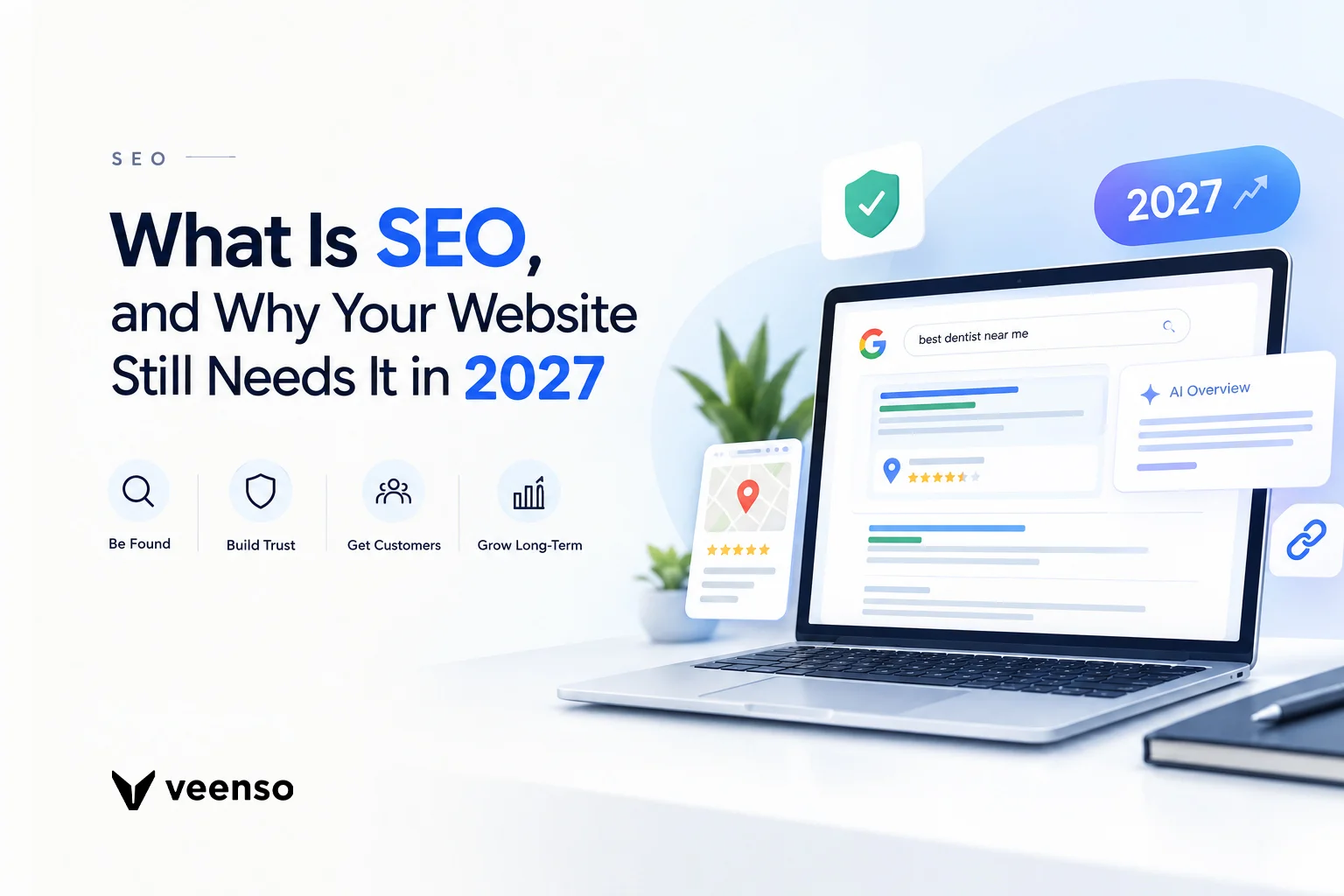
What Is SEO, and Why Does Your Website Still Need It in 2027?
There was a time when you could rank a page by repeating a keyword twenty times and tucking a few more into white text. Since then, search has been reshaped by Panda, Penguin, mobile-first indexing, voice search, and now AI-generated answers appearing directly in search results.
Every couple of years, someone declares that SEO is dead. Every couple of years, they're wrong.
So here we are, almost 2027, and the question is a fair one: Is search engine optimization still worth your time and budget?
Short answer: yes. For many businesses it is more valuable than ever, but the way SEO works has changed. Here's the honest case, including the parts that have changed.
What Is SEO?
Search engine optimization (SEO) is the work of making your website easier for search engines to find, understand, and trust, so it appears when potential customers search for what you sell or do. Several layers work together:
- Technical SEO: Your site loads quickly, works well on mobile, and can be crawled and indexed without problems. If search engines can't access your site, everything else becomes harder.
- Content and on-page SEO: Your pages answer real questions, match search intent, use clear language, and demonstrate genuine knowledge.
- Authority and trust: Reputable websites mention or link to you, customers leave reviews, and your business information is consistent across the web.
- Local SEO: For businesses serving specific areas, your Google Business Profile, reviews, and location pages become especially important.
Good SEO makes your business easy to understand, easy to find, and worth choosing.
"Isn't SEO Dead Because of AI?"
It's one of the biggest questions business owners are asking right now, and it deserves a straight answer rather than a sales pitch.
AI has changed search. A 2026 randomized field experiment found that Google AI Overviews reduced outbound organic clicks by about 38% on queries where they appeared, while zero-click searches rose from 54% to 72%. Seer Interactive's research found that brands cited within AI Overviews earned higher click-through rates than uncited brands, although its researchers caution that correlation doesn't prove the citation caused the difference.
If your entire strategy was publishing basic "what is..." articles and hoping for clicks, you may already be feeling it.
But look at the full picture. Organic search hasn't disappeared. Graphite's analysis of roughly 40,000 websites found U.S. organic search traffic down only about 2.5% year over year, far from the 25% to 50% collapse some commentators predicted.
And the opportunity is no longer just a blue link. It's being visible wherever your customers look for answers: traditional results, local results, product listings, AI Overviews, and other AI-powered search experiences. The tactics have matured, but the goal hasn't: be the most useful, credible answer to the question your customer is asking.
Why Your Website Needs SEO in 2027
1. Search is still where buying decisions begin
When someone needs a dentist, a divorce attorney, or a new pair of running shoes, they search. Google still dominates, holding roughly 85% of the U.S. search-engine market as of September 2026, according to StatCounter.
More importantly, search captures intent. Someone searching "emergency dentist open Saturday near me" isn't casually browsing. They have an urgent problem. If your business is invisible at that moment, your competitor gets the call.
2. Most websites are invisible
Ahrefs' analysis of roughly 14 billion pages found that 96.55% received zero organic traffic from Google. Ahrefs notes that this reflects its own index and estimated traffic, so treat it as a directional finding, not a universal measurement.
The drop-off within results is steep too. Backlinko found that only about 0.63% of searchers clicked a result on page two. Visibility is the product of strategy. A beautiful website that nobody discovers is still a missed business opportunity.
Start with the foundation. Search visibility begins with a fast, clean, mobile-friendly website.
Explore our Web Design & developement→
3. Organic visibility can compound
Paid advertising generates visibility quickly, but the traffic generally stops when the campaign does. A strong service page, product page, or genuinely useful article can keep attracting qualified visitors long after it's published.
That doesn't mean SEO is passive: rankings shift and content needs maintenance. But a well-built organic presence can become a long-term business asset.
4. Search captures high-intent customers
Not all traffic has the same value. Someone searching "what is Invisalign?" may still be researching. Someone searching "Invisalign dentist in Austin" is much closer to choosing a provider.
This is why effective SEO focuses on search intent, not just search volume: the goal is the right visitors at the right stage of their decision.
5. Trust matters more than ever
Google's Search Quality Evaluator Guidelines emphasize experience, expertise, authoritativeness, and trustworthiness, commonly called E-E-A-T.
Real author information, accurate claims, first-hand experience, legitimate reviews, and transparent business details all help. And as AI systems decide which sources to summarize or cite, being a credible source becomes even more valuable. In 2027, credibility isn't a nice extra. It's part of the foundation.
Who Benefits Most From SEO?
Lawyers
Legal search is highly competitive and often extremely valuable. Someone searching for a personal injury, family, or immigration attorney may need help immediately. Strong practice-area pages, attorney bios, location relevance, reviews, and accurate legal content can turn those searches into consultations.
Dentists and Medical Practices
Patients compare providers before booking. They search for a dentist nearby, a specific treatment, emergency care, or reviews. Local SEO, a well-maintained Google Business Profile, and useful service pages put a practice in front of patients who are already looking.
E-commerce Owners
Product and category pages can capture commercial searches without paying for every click. Clean site architecture, useful product information, fast performance, and structured data all help, and comparison pages and buying guides keep a brand visible as AI summaries grow.
SEO Specialists and Agencies
The job is no longer simply "get these 20 keywords to position #1." The best specialists balance technical performance, search intent, content quality, and AI-search visibility, and connect it all to qualified leads, calls, sales, and revenue, not just rankings.
Want more organic visibility?
Explore our SEO Service →
and see how we help businesses attract more qualified, high-intent customers.
What Good SEO Looks Like Heading Into 2027
Algorithms change constantly, but the fundamentals have proven remarkably durable.
What hasn't changed: fast, mobile-friendly, secure websites; content written for people first; clear site architecture; accurate information; links earned rather than manipulated; and patience.
What has changed:
- Write for answers, not just keywords. Lead with a clear answer, then add useful depth. Well-structured content is easier for people to scan and for search systems to interpret.
- Show real expertise. Original insight, first-hand experience, named authors, and genuine examples are harder to replace with generic AI copy. If a tool can produce your page in ten seconds, so can your competitor.
- Build your brand, not just your pages. Reviews, mentions, credentials, and consistent business information shape how your business is understood across the web.
- Measure what matters. Rankings and traffic are diagnostics, not the final objective. Track qualified leads, calls, purchases, and revenue. In an AI-influenced search environment, fewer clicks with stronger intent can still produce a better business outcome.
SEO and AI Search Optimization Are Converging
AI search optimization, often discussed as AEO (Answer Engine Optimization) and GEO (Generative Engine Optimization), focuses on making your business understandable and potentially visible inside AI-generated answers. It relies on the same foundations as modern SEO: authoritative content, consistent business information, credible mentions, structured data, demonstrated expertise, and a technically accessible website.
The objective is no longer just to rank a page. It's to build a digital presence that search engines and AI systems can understand, trust, and potentially reference.
So, Is SEO Still Necessary?
If you want customers to find you without renting every click, yes.
SEO won't deliver overnight results, and anyone promising guaranteed rankings or instant traffic should make you nervous. But it remains one of the few marketing disciplines that builds an asset over time: an online presence that earns attention, trust, and customers month after month.
Search has changed shape, but people still have questions, still compare businesses, and still research before they buy. The businesses that give the best answers and make themselves easy to find keep the advantage. That was true before AI, it's true today, and it will still matter in 2027.
Ready to Get Found?
Your website should be more than an online business card. It should be a foundation for visibility, credibility, and growth.
Not sure where to start?
for a straightforward conversation about your website, search visibility, and growth goals.
In 2027, being online is not enough. Being discoverable matters.
Sources and data notes: Ahrefs page-traffic research; Backlinko click-through study; Search Engine Journal's report on the randomized AI Overviews field experiment; Seer Interactive's AI Overview CTR research; Graphite's analysis of U.S. organic traffic across roughly 40,000 websites; StatCounter's U.S. search-engine market share data for September 2026. Statistics reflect the methods and datasets of their respective studies and should not be treated as universal benchmarks.