SEO vs. AEO: Why Your Business Needs Both for Search Visibility | Veenso
Discover how SEO and AEO work together to improve search visibility, build credibility, and help customers find your business on Google and AI search.
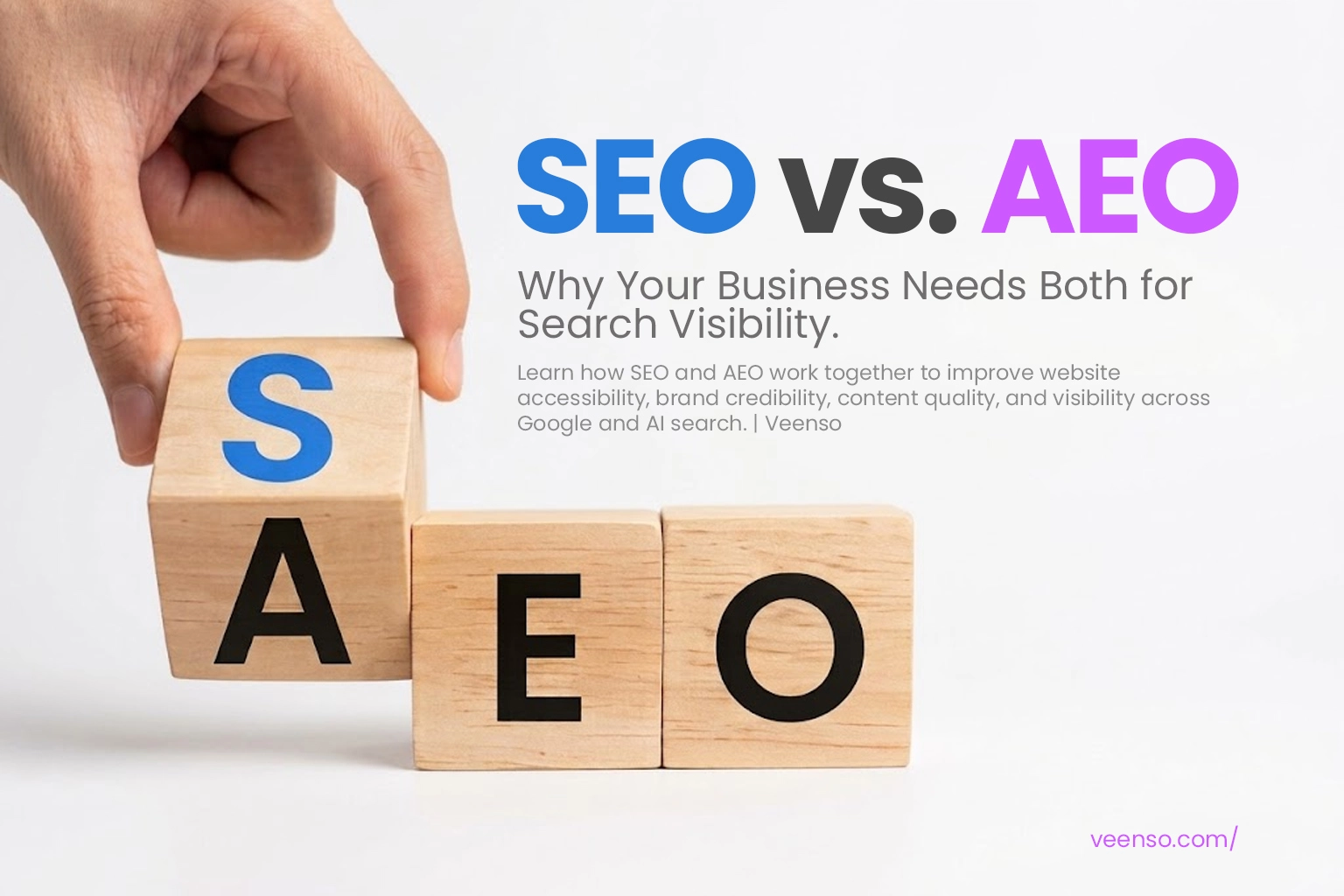
SEO vs. AEO: Why Your Business Needs Both for Search Visibility
October 27, 2026 · By Amjadul Huq
Imagine two people searching for a family dentist in Austin. One opens Google and compares local results, websites, and reviews. The other asks an AI tool, “Can you recommend a family dentist in Austin who accepts new patients?”
Both want the same service, but they discover businesses in different ways. That is why businesses need to think beyond traditional rankings. SEO remains important, while answer engine optimization (AEO) helps make business information easier for answer-driven systems to understand and use.
The goal isn't to choose between SEO and AEO. It's to build a strong online presence that supports both.
What Is the Difference Between SEO and AEO?
Search Engine Optimization (SEO) improves a website's visibility in organic search results. Answer Engine Optimization (AEO) makes information easier for answer-driven systems to retrieve, interpret, and use when responding to questions. Their emphasis differs, but they share many of the same foundations.
| Factor | SEO | AEO |
|---|---|---|
| Primary goal | Improve organic search visibility | Make information accessible to answer-driven experiences |
| Typical journey | Search, compare results, visit a website | Ask a question, receive an answer, potentially visit a source |
| Core activities | Technical SEO, keywords, content, internal links, authority | Clear answers, structured information, credible sources |
| Success measures | Rankings, clicks, traffic, leads | Citations, brand mentions, qualified visits and inquiries |
Four Foundations That Support SEO and AI Search Visibility
1. Make Your Website Accessible and Easy to Understand
Search engines need to discover and interpret your pages before they can include them in search results. AI-powered search experiences may also retrieve information from accessible web content, depending on the platform and its retrieval methods.
Start with these fundamentals:
- Organize your website with clear navigation and descriptive URLs.
- Write useful page titles and descriptive headings.
- Connect related pages through relevant internal links.
- Ensure important content is accessible and readable.
- Fix broken links, indexing problems, and rendering issues.
- Review crawler permissions for the platforms you want to reach.
Structured data can help search engines interpret eligible information about your business, services, and content. However, schema markup alone does not guarantee rankings, enhanced search results, or AI citations.
2. Build Credibility Beyond Your Website
Your website explains what your business offers. Other credible sources can help people verify your claims.
Genuine customer reviews, relevant third-party mentions, professional credentials, and consistent business information all contribute to your wider digital presence.
For example, a law firm can communicate credibility through accurate attorney biographies, detailed practice-area pages, and verifiable professional credentials. A dental practice can provide clear provider information, authentic patient reviews, and reliable explanations of treatments.
Focus on earning genuine recognition rather than manufacturing reviews or mentions. Keep your business name, contact information, services, and other important facts consistent across your website and relevant external profiles.
3. Create Content That Answers Real Customer Questions
Keyword research remains important, but effective content should do more than repeat search terms. It should answer the questions behind them.
Consider a dental practice creating a page about dental crowns.
| Before | After |
|---|---|
| Opening: “We provide exceptional, patient-centered dental care.” | “A dental crown covers a damaged or weakened tooth to help restore its shape, function, and strength.” |
| Structure: A long block of promotional copy | Clear sections explaining common uses, the procedure, aftercare, and cost factors |
| Next step: A generic contact link | A clear appointment option with the practice's phone number and relevant contact details |
The improved version gives readers specific information they can use to understand the treatment and decide what to do next. Medical and dental information should always be accurate and supported by reliable sources.
Apply the same principle to your other service pages:
- Answer the main question directly, then provide supporting details.
- Use descriptive headings and specific language.
- Include relevant examples, evidence, and expert input.
- Link to related services and genuinely helpful resources.
- Review important information regularly to keep it accurate.
Clear, useful content serves your audience first and can also help search systems interpret the information.
4. Measure More Than Traditional Rankings
Rankings are valuable, but they don't tell the whole story. A page may attract organic traffic without generating leads, while an AI-generated answer may mention your business without producing a direct click.
Measure both visibility and business outcomes.
| Measurement area | Traditional SEO | AI search visibility |
|---|---|---|
| Visibility | Rankings, impressions, clicks | Brand appearances in relevant AI answers |
| Source recognition | Relevant backlinks and referring domains | Whether your website is cited as a source |
| Business outcomes | Calls, form submissions, bookings, qualified leads | Qualified visits and inquiries associated with AI-driven discovery |
AI results can vary by platform, query, location, and time. Track a consistent set of relevant customer questions periodically, record the results, and look for patterns rather than treating a single response as definitive evidence.
Where reliable analytics are available, connect visibility data to website visits, inquiries, and conversions. The goal is to understand whether your search strategy is reaching the right audience and supporting business growth.
Should You Prioritize SEO or AEO?
For most businesses, these approaches should complement one another rather than operate as entirely separate strategies.
A practical starting point is to strengthen your SEO foundation and then extend your efforts to support AI-driven discovery.
- Fix technical issues so important pages can be crawled, rendered, and indexed.
- Improve key service pages so they answer customer questions clearly and accurately.
- Align business information across your website and relevant external profiles.
- Build genuine credibility through useful content, authentic reviews, and relevant third-party recognition.
- Track performance consistently across organic search, website conversions, and available AI visibility signals.
You don't need to abandon proven SEO practices to prepare for AI search. You need a strategy that builds on them.
Explore our SEO Service →
Frequently Asked Questions
Is SEO still worth investing in as AI search grows?
Yes. Traditional search remains an important discovery channel, and technical accessibility, useful content, and credible information can support visibility across multiple search experiences.
Does schema markup guarantee AI citations?
No. Structured data can help search engines interpret eligible information, but it does not guarantee rankings, AI citations, or recommendations.
How can I check whether my business appears in AI answers?
Test relevant customer questions across the AI search platforms your audience uses. Repeat the checks periodically and record brand mentions, citations, and any resulting website traffic or inquiries. Remember that results may vary.
Do I need separate content for AEO?
Not necessarily. Well-organized pages that answer genuine customer questions with accurate information can support both SEO and AI search visibility. Additional content should address real gaps in your customers' needs, not simply duplicate existing pages.
Build a Search Strategy That Goes Beyond Rankings
Your business shouldn't depend on a single discovery channel. A strong digital presence helps potential customers find your website, understand your services, assess your credibility, and decide whether to contact you.
At Veenso, we help businesses improve their websites, strengthen organic search visibility, and build a clearer digital presence for evolving search experiences.
SEO and AEO are complementary parts of a broader search strategy. The goal is to make your business discoverable, understandable, credible, and useful wherever potential customers look for answers.
Want to identify opportunities to improve your search visibility? Contact Veenso to discuss your website, SEO, and AI search visibility goals.