Why Every Professional Needs a Personal or Business Website
Your website is your digital office. Discover why professionals need a personal or business website to build trust, improve search visibility, and attract clients.
Why Every Professional Needs a Personal or Business Website
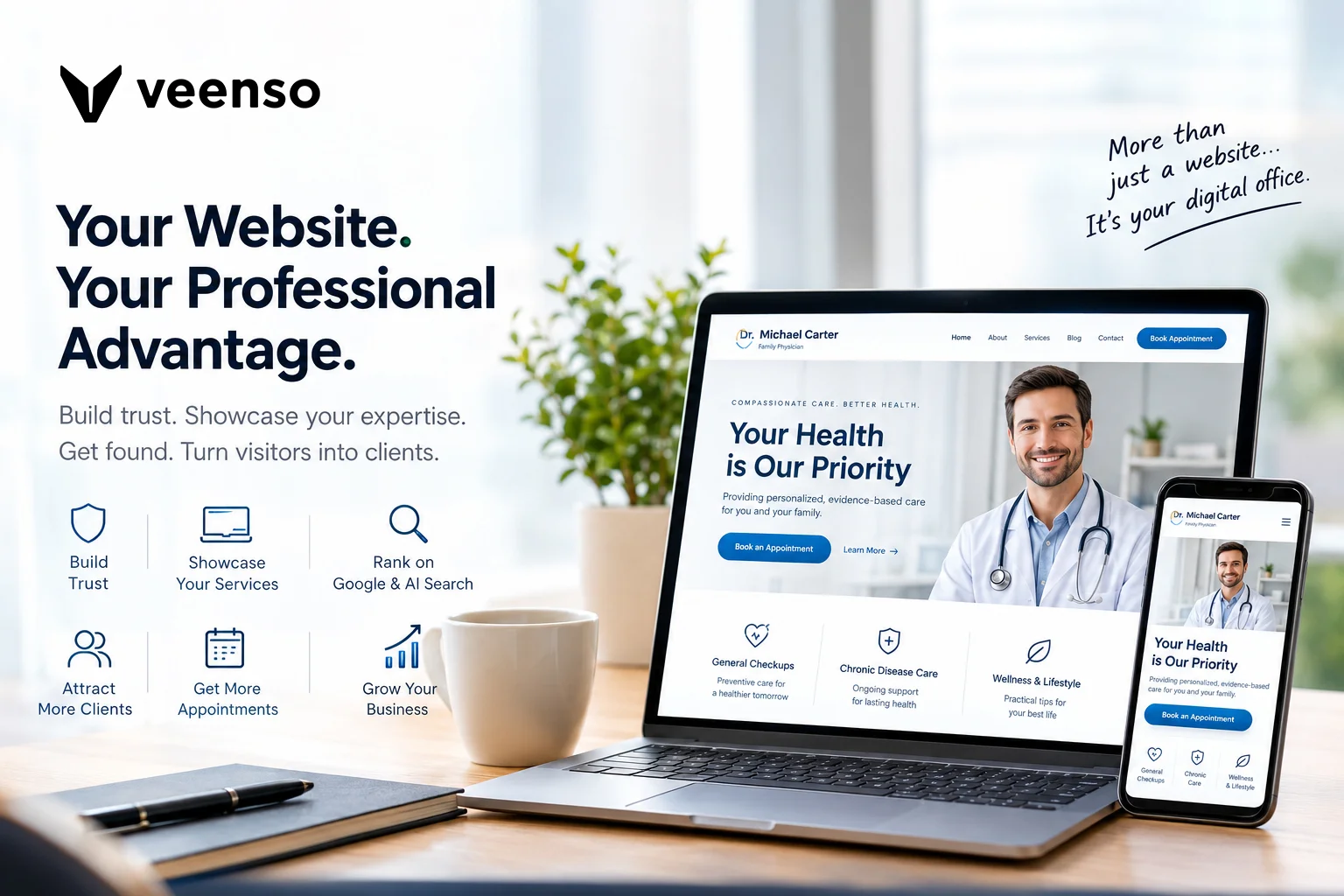
Your website is your digital office. What first impression is it making?
Before contacting a dentist, lawyer, doctor, accountant, consultant, or real estate professional, many potential clients search online first. They want to know who you are, what you offer, whether they can trust you, and how to reach you.
Your website is often where they find those answers, and where they decide whether to contact you or keep looking.
Personal Website vs. Business Website
Not every professional needs the same type of website. The right approach depends on whether you are the brand or your company is the brand.
Personal Website
A personal website centers on you as the professional. It can be particularly useful for doctors, lawyers, consultants, accountants, coaches, architects, freelancers, and other experts whose reputation is closely connected to their name.
A personal website can showcase your:
- Professional biography
- Credentials and qualifications
- Experience
- Areas of expertise
- Publications and achievements
- Testimonials
- Portfolio or case studies
- Contact information
It gives potential clients a dedicated place to learn about you beyond a social media profile or third-party directory.
Business Website
A business website centers on the company or brand.
For example, a dental clinic with several dentists, a law firm with multiple attorneys, or a real estate agency with a team will usually organize its website around services, locations, team members, case studies, reviews, and customer resources.
In many cases, the best approach is a combination: a strong business website with a dedicated profile page for each professional behind it.
7 Reasons Professionals Need a Website
1. Build Credibility Before the First Conversation
When someone searches for your name or business, what they find can shape their first impression.
A website gives you a dedicated space to present your real credentials, experience, services, and professional background.
A website does not automatically create trust. Instead, it gives you the opportunity to demonstrate credibility with accurate, useful information.
For example, a lawyer can explain their areas of practice and professional experience. A doctor can provide information about their specialties and qualifications. A consultant can showcase relevant projects and expertise.
Your website should help potential clients understand who you are and what you can offer.
2. Take Control of Your Personal Brand
LinkedIn, Instagram, Facebook, and other platforms can help you reach people, but your profile exists within someone else's platform and rules.
Your website gives you greater control over:
- Your messaging
- Your visual identity
- Your professional biography
- Your services
- Your portfolio
- Your educational content
- Your contact experience
Someone may discover you through LinkedIn, social media, Google, or another platform. Your website can then become the central destination where they learn more about you.
3. Explain Your Services Clearly
A visitor may understand what you do and still not know whether you can help them.
Instead of using a vague description such as "Professional Consulting Services," explain:
- What you help clients accomplish
- Who the service is for
- What the service includes
- What makes your approach different
- What the visitor should do next
Clear service pages reduce confusion and help potential clients determine whether your services are right for them.
4. Help Potential Clients Find You
A website doesn't guarantee Google rankings, but a well-structured website provides an important foundation for SEO.
Search engines need to understand what you do, where you operate, who you serve, and what information your pages provide.
Important SEO foundations can include:
- Clear page titles
- Descriptive headings
- Helpful, original content
- Internal linking
- Descriptive URLs
- Mobile-friendly design
- Fast page performance
- Accurate business information
- Appropriate structured data
The goal shouldn't be to repeat keywords as many times as possible. Instead, create useful content that answers the questions your potential clients are actually asking.
5. Turn Visitors Into Leads
Website traffic alone doesn't grow a professional practice or business.
Your website should make the next step easy for interested visitors. Depending on your profession, that might mean:
- Book an appointment
- Request a consultation
- Call your office
- Request a quote
- Submit an inquiry
- Send a message
For example, a dental clinic can place an appointment option near its treatment information. A law firm can provide an initial inquiry form. A consultant can offer a consultation request after explaining a service.
The goal isn't to pressure every visitor. It's to make taking the next step simple for people who are ready.
6. Prepare Your Business for AI-Powered Search
Search behavior is evolving. People increasingly use conversational and AI-powered tools to research businesses, services, products, and professional information.
This creates another reason to publish clear, accurate, and well-structured information on your website.
AI Search Optimization, sometimes referred to as AEO (Answer Engine Optimization) or GEO (Generative Engine Optimization), focuses on making information easier for modern search and AI systems to understand and retrieve.
There is no legitimate strategy that can guarantee your business will appear in a particular AI-generated answer. However, you can make your information easier to understand by providing:
- Clear service descriptions
- Direct answers to common questions
- Accurate professional information
- Well-organized content
- Relevant educational resources
- Strong topical coverage
The principle remains simple: create useful information for people first.
7. Build a Long-Term Digital Asset
A social media post may generate attention today and disappear from people's feeds tomorrow. A useful website can continue working for your business over a much longer period.
Over time, you can build a library of:
- Service pages
- Educational articles
- Case studies
- FAQs
- Professional resources
- Portfolio projects
- Guides
- Videos
These resources can give potential clients more opportunities to discover your business and understand your expertise.
Your website can become a long-term digital asset, rather than simply another profile on the internet.
What Should a Professional Website Include?
The exact structure depends on your profession and business goals, but most professional websites benefit from a clear foundation.
Home Page
Explain who you are, what you offer, who you serve, and what visitors should do next.
About Page
Present your professional background, experience, credentials, and relevant achievements.
Service Pages
Give each important service enough space to explain what it is, who it is for, and how visitors can get started.
Experience or Portfolio
Show relevant projects, case studies, publications, achievements, or professional experience.
Reviews or Testimonials
Where appropriate, include authentic customer feedback that helps visitors understand the experience of working with you.
Blog or Resources
Publish useful information that answers questions your potential clients are searching for.
Contact Page
Make it easy for visitors to call, email, submit an inquiry, request a consultation, or book an appointment.
Signs Your Website May Need an Upgrade
Your website may need improvement if:
- It looks outdated or hasn't been updated in years
- It doesn't display properly on mobile devices
- It loads slowly
- Visitors can't quickly understand what you offer
- Your contact information is difficult to find
- You rarely receive inquiries through your website
- Important services don't have dedicated pages
- Your website has little useful content
- Your business information is outdated
- You aren't visible for relevant local searches
If several of these sound familiar, your website may be creating unnecessary friction for potential clients.
Common Website Mistakes Professionals Should Avoid
Designing Only for Appearance
A beautiful website is not necessarily an effective website. Visitors should be able to understand your services and find important information quickly.
Ignoring Mobile Users
Your website should work properly across smartphones, tablets, and desktop computers. Text, navigation, buttons, images, and forms all need to remain usable on smaller screens.
Using Generic Content
Your content should reflect your actual expertise, services, audience, and business. Avoid publishing repetitive or generic pages simply to target keywords.
Keyword Stuffing
Repeating keywords unnaturally can make content difficult to read and create a poor user experience. Write naturally and focus on answering your audience's questions.
Making Unsupported Claims
Avoid promises such as "number one on Google," "guaranteed rankings," or "guaranteed leads." Your website should communicate realistic and verifiable information.
Hiding the Contact Option
If someone is ready to contact you, they shouldn't have to search through several pages to figure out how.
A Note for Regulated Professions
Doctors, lawyers, dentists, accountants, and other regulated professionals should make sure that website claims, testimonials, credentials, and advertising practices follow the relevant rules in their region.
Your professional information should be accurate, current, and transparent. This matters not only for your visitors but also for building a trustworthy online presence.
Does Your Website Reflect Your Professional Brand?
Your website doesn't need to be the biggest in your industry. It needs to be useful, credible, clear, fast, mobile-friendly, search-friendly, and aligned with your business goals.
For some professionals, the priority may be building a personal brand. For others, it may be generating appointments, consultation requests, or leads. For an established company, it may be building a stronger brand presence across multiple marketing channels.
The right website depends on what you want your business to accomplish.
Build a Website That Works for Your Business
At Veenso, we build websites around business objectives, not simply attractive pages.
Our approach combines Website Design & Development, SEO, AI Search Optimization, Branding & Graphic Design, Content, and Lead Generation to create a stronger digital foundation for professionals and growing businesses.
If your current website doesn't reflect the quality of your work, or if you don't have a professional website yet, it may be time to evaluate what you're missing.
Want to know how your website measures up?
Contact Veenso for a free website review and discover practical opportunities to improve your website, search visibility, user experience, and lead-generation potential.
Your website is your digital office. Make sure it represents your business well.
Frequently Asked Questions
Do professionals really need a personal website?
A personal website gives you an independent online presence where you can showcase your expertise and credentials, explain your services, and give potential clients one place to learn about you. Even when someone discovers you through a referral or social media, your website can provide additional information before they contact you.
What's the difference between a personal website and a business website?
A personal website focuses primarily on one professional and their expertise. A business website focuses on the company, including its services, team, locations, products, and customers.
Does a website guarantee higher Google rankings?
No. A website provides a foundation for SEO, but rankings depend on many factors, including relevance, content quality, competition, technical health, authority, and search intent.
Can a professional website generate leads?
A website can support lead generation by attracting relevant visitors, explaining your services, building credibility, and making it easy to contact you. Results depend on your market, offer, traffic sources, website quality, and other factors.
Should professionals have a blog?
A blog can be valuable when it publishes genuinely useful information for your audience. It shouldn't exist simply to produce large amounts of keyword-focused content.
Should my website be optimized for AI search?
Publishing clear, accurate, and well-structured information can make your website easier for modern search and AI systems to understand. However, no legitimate strategy can guarantee inclusion in AI-generated answers.
About the Author
Amjadul Huq is the Founder of Veenso, a digital marketing agency helping professionals and growing businesses build stronger online brands through website design, SEO, AI Search Optimization, branding, content, and lead generation.